Why AI Agents Don't Care About Your Balance Sheet
 Ian Edwards
Ian is a senior engineer and the founder of Tessellium. Combining over a decade of technical experience with his background as a business owner, he specializes in untangling complex operational bottlenecks and getting stalled software projects over the finish line.
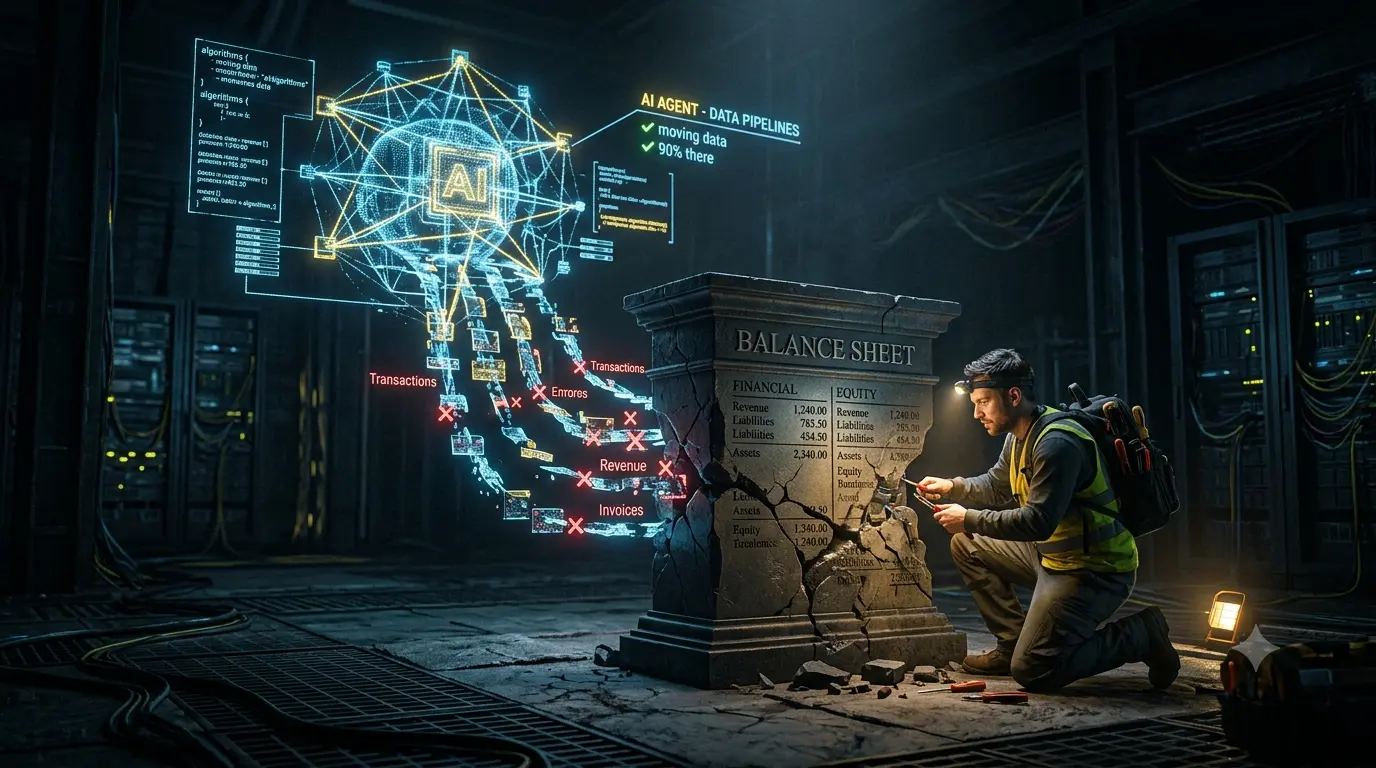
We have reached peak automation hype, and it has made us tolerant of broken data.
If you ask a modern AI assistant to draft a market analysis, it will deliver it in seconds. If you use a low-code tool to map a webhook from a custom web form to your CRM, it takes about three clicks. The barrier to entry for moving data has dropped to zero.
Because the initial setup is so effortless, it creates a psychological trap. You watch a single test payload slide across your screen, see a success notification, and conclude that you are almost there.
But in systems architecture, the final mile of an integration is where the real work lives. It’s where you confront the disadvantages of data automation - the managing of API rate limits, enforcing schema validation, and writing code for messy edge cases. When you delegate that final mile to self-serve platforms or probabilistic AI models, you aren’t actually automating your business - you are just delegating a future accounting crisis to a tool that cannot feel regret.
The Illusion of the Straight Line
The core marketing pitch for modern no-code software is that data integration is a simple plumbing problem. You connect Pipe A to Pipe B, and the data flows like water.
This works fine in a controlled environment. It fails immediately in production because applications do not share a common language. They operate on entirely different relational structures and business rules. True integration isn’t just data movement; it’s structural translation.
When non-technical teams use AI or basic visual logic to bridge these gaps, they almost always design for the happy path - the ideal scenario where every input is flawless. And there’s nothing wrong with that. When you’re doing something outside of your comfort zone, even achieving the basics feels like a huge win.
Consider a standard e-commerce transaction. Your front-end checkout might collect a single, unstructured text field called Billing Name. Your back-end CRM, however, strictly requires two independent variables: First Name and Last Name. A basic low-code workflow applies a generic text-split rule. It runs smoothly until a customer signs up as “Jones & Jones Engineering” or “Dr. David Jenkins-Smythe.” Without defensive coding at the gate, the rule breaks, data fragments, and a malformed record is pushed into your database.
The stakes get higher when data hits your ledger. An e-commerce platform passes an order containing an item described as Premium Enterprise Suite. Your accounting engine doesn’t work on marketing titles; it requires a specific alphanumeric ledger code based on the customer’s tax residency and corporate structure.
Because an AI agent or a standard automation module doesn’t possess explicit, deterministic guardrails for these logic loops, it either makes a probabilistic “smart guess”, or blindly forces the unvalidated data through.
Forensic Translation
When you allow unsanitized data to pass from system to system, your automation shifts from an asset to a liability.
A system that fails loudly on day one is safe because you know it’s broken. The danger lies in the system that fails silently - the pipeline that works beautifully for three weeks, hits an unmapped tax exception on week four, doesn’t crash, but simply records the transaction incorrectly and moves on.
You don’t notice the break until your end-of-month reporting doesn’t balance. Suddenly, the time your team saved by automating the workflow is lost. Your operations manager or fractional CFO has to stop doing strategic work, log into your core systems, and spend hours playing digital archaeologist - manually auditing execution logs, reversing duplicate profiles, and unpicking reconciliation errors.
The Accountability Vacuum
This brings us to the elephant in the room: Who owns the downside?
When you build critical data infrastructure using a self-serve platform or an AI assistant, you are operating in an accountability vacuum. If you dive into the enterprise terms of service for any major automation or AI provider, you will find they’re all legally insulated. They explicitly disclaim any liability for data loss, financial discrepancies, system downtime, or downstream business interruption caused by their tools.
If an automated pipeline drops a billing webhook or mismaps a ledger category, the software company will not pick up the phone. They sell the sandbox; you own the wreckage. For a scaling business managing real transaction volumes and strict client commitments, leasing a vital operational link without an engineering safeguard is a risky trade.
Engineering the Perimeter
We have a straight-forward philosophy: if your team is still reviewing error logs, chasing sync failures, or worrying about whether your apps are secretly breaking your data, you haven’t automated anything.
We don’t rely on smart guesses or fragile, unmonitored patches. We approach integration through the lens of dedicated systems engineering. We build robust data pipelines with perimeter validation in mind from the beginning.
Our infrastructure sanitizes and translates your data layers before they ever touch your production environments or core financial ledgers. If a payload contains a structural mismatch, a messy string, or an ambiguous mapping, our system isolates it at the perimeter before it can cause downstream issues.
Most importantly, we don’t just hand you a tool and leave you holding the bag. Tessellium operates as a managed utility for a flat monthly fee. You are investing in an engineering service-level agreement (SLA). We monitor your infrastructure continuously. If an external API updates its schema or an integration hits a rare exception in the dead of night, it is our responsibility to deploy a patch and resolve the breakdown before your business day even begins.
Stop treating critical data movement like an afterthought. Let software platforms do what they are designed for, and let an engineering partner protect your balance sheet.
Are messy integrations and unmapped data fields quietly draining your team’s energy? Stop playing digital forensic scientist. We’ll audit your workflows and build automated pipelines that run silently and securely.