Stop Being the Dashboard: How to Delegate Automation Trust Without Losing Visibility
 Ian Edwards
Ian is a senior engineer and the founder of Tessellium. Combining over a decade of technical experience with his background as a business owner, he specializes in untangling complex operational bottlenecks and getting stalled software projects over the finish line.
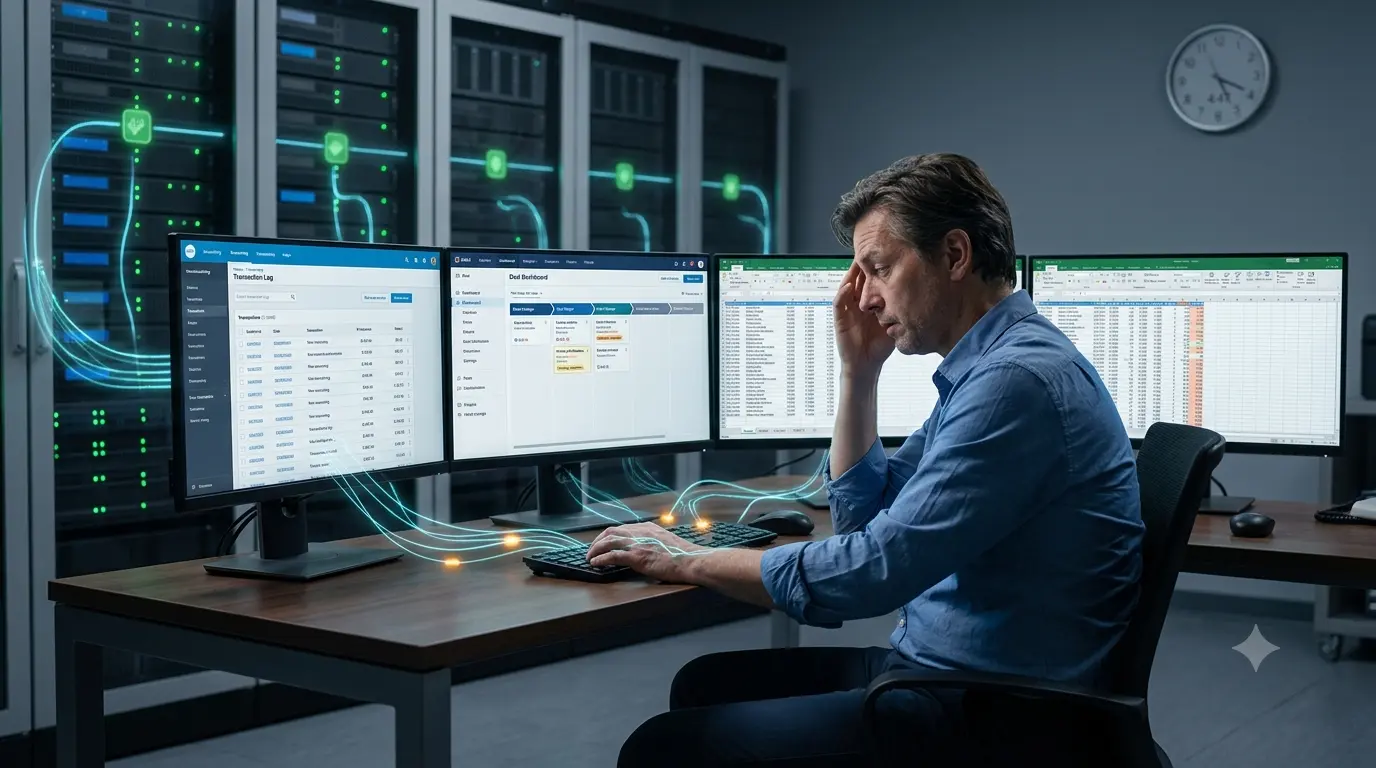
Every Friday at 4:47 PM, the same scene plays out.
An operations manager opens Xero in one tab, their CRM in another, and a spreadsheet on a second monitor. They’re not doing strategy. They’re not coaching their team. They’re manually verifying that the invoices the automation sent actually landed. That the Stripe webhook didn’t silently fail. That the inventory sync didn’t duplicate half the catalogue. They have become the dashboard.
We build automations for a living, and we see this pattern constantly. A business invests in workflow automation, API integrations, maybe even a custom pipeline. Six months later, their highest-paid operations person is still spending five hours a week checking that the automation worked.
The Verification Leak
Let’s put a number on it.
| Role | Hourly Cost | Weekly Verification Hours | Annual Cost |
|---|---|---|---|
| Operations Manager | £65 | 5 | £16,900 |
| Fractional CFO | £150 | 3 | £23,400 |
| Founder (opportunity cost) | £200+ | 4 | £41,600+ |
And that’s just the direct time. It doesn’t count the mental load of “did I check the invoices?” pinging at 10 PM on a Sunday. The context switching. The decisions delayed because you were busy being a human scheduled job.
We wrote about how human middleware taxes growing businesses — this is the same tax, just collected differently. Instead of copying data between systems, you’re copying trust between systems and your brain.
Why Verification Becomes a Habit
It starts reasonably. You build an automation. You watch it run the first few times. You check the outputs. It works. You check a few more times. It keeps working.
Then you get busy - you stop checking for a week. Nothing breaks, so you stop checking for a month.
Then something does break. A token expires, an API changes a field name, a webhook fires twice. The automation runs happily, reports success, and produces junk data.
You catch it two weeks later during reconciliation. You vow to stay on top of it this time. The verification habit returns, stronger than before.
The problem isn’t the habit. The problem is that manual verification doesn’t scale, but silent failure does.
The Trust Architecture
Most automations are built with a binary mindset: it works or it fails. Production systems need a third state: it ran but the output is suspect.
You earn the right to stop checking by building three layers of visibility that don’t require you to log in.
Layer 1: Execution Visibility (Did it run?)
The most basic verification. Every automation should emit a heartbeat:
✅ Job started at 02:00 UTC
✅ Fetched 847 records from Xero API
✅ Transformed 847 records (0 validation errors)
✅ Loaded 847 records to warehouse
✅ Job completed in 2m 34s
If this log doesn’t exist, you are the monitoring. If it exists but you have to log into a server to read it, you’re still the monitoring - just with worse UX.
The test: Can you see the last 30 runs of every critical automation in one dashboard, without logging into the execution environment?
Layer 2: Data Quality Visibility (Did it produce correct results?)
Execution success is not the same as data correctness. This is where AI agents don’t care about your balance sheet and where naive automations silently corrupt downstream systems.
You need assertions on output, not just exit codes:
| Assertion Type | Example | Failure Action |
|---|---|---|
| Row count bounds | Invoice count 800-900 | Alert + halt downstream |
| Referential integrity | Every invoice has valid contact_id | Alert + quarantine |
| Business rule | Net amount = gross - tax ± £0.01 | Alert + flag for review |
| Freshness | Max invoice date < 48 hours ago | Alert + escalate |
| Schema conformity | All required fields present, correct types | Alert + reject batch |
These run inside the pipeline, not as a separate audit step. They turn “I should check” into “the system told me.”
Layer 3: Business Impact Visibility (Does anyone care?)
Your automation produced 847 invoices. So what?
- How many were over £10k? (Finance cares)
- How many went to new customers? (Sales cares)
- How many had payment terms > 30 days? (Cash flow cares)
Business impact dashboards answer “so what?” automatically. They transform technical success into operational signal. When the dashboard shows “12 high-value invoices, 3 new customers, 0 overdue terms,” you don’t need to check the raw data. The dashboard is the verification.
Delegation
You don’t go from “checking everything” to “trusting blindly” in one step. You climb a ladder:
| Rung | Operator Action | Automation Responsibility |
|---|---|---|
| 1. Manual verification | Checks every run, every field | Runs and reports success/fail |
| 2. Exception-only review | Reviews only flagged anomalies | Runs, validates, surfaces exceptions |
| 3. Dashboard trust | Glances at business impact dashboard | Runs, validates, summarizes business impact |
| 4. Alert-only | Acts only on alerts | Runs, validates, summarizes, self-heals common failures |
| 5. True delegation | Forgets it exists until strategy review | Runs, validates, self-heals, reports trends |
Most businesses stall at Rung 1 or 2. They build the automation but not the observability that makes Rung 3 possible.
What Rung 3 Looks Like in Practice
One of our clients runs a mid-market wholesale operation. Their nightly pipeline syncs orders from Shopify → ERP → warehouse → finance.
Before (Rung 1): Operations director spent 45 minutes each morning cross-referencing order counts across three systems. “Just making sure nothing fell through.”
After (Rung 3): A single dashboard shows:
- Orders synced: 1,247 (expected 1,200-1,300)
- High-value orders (>£5k): 23 — all accounted for
- Failed validations: 2 (both missing warehouse SKUs)
- Warehouse sync lag: 4 minutes
- Finance reconciliation delta: £0.00
He opens it at 8:05 AM. Sees two warnings. Clicks through, sees the SKUs, forwards to procurement. Done by 8:12 AM.
He didn’t verify the automation. He acted on its intelligence.
That’s the difference. Verification asks “did it work?” Intelligence asks “what needs my attention?”
Building Your Way Up the Ladder
You don’t need a data platform team. You need three commitments:
1. Treat observability as part of the automation, not an afterthought
Every pipeline we build ships with:
- Structured logging to a queryable store (not text files on a server)
- Built-in validation assertions with configurable thresholds
- A business-facing summary dashboard (Grafana, Metabase, even a well-designed Google Sheet)
If the automation budget doesn’t include observability, the automation isn’t finished.
2. Define “normal” explicitly
You can’t alert on anomalies if you haven’t defined the baseline. Document:
- Expected row counts per run (with acceptable variance)
- Critical business rules that must never break
- SLA for data freshness (e.g., “orders visible in finance within 1 hour of placement”)
This is deciding what to automate applied to monitoring: automate the watching, not just the doing.
3. Close the loop on every alert
An alert that gets ignored teaches the system that alerts are noise. Every alert needs:
- A clear owner
- A defined response playbook
- A post-incident update to the validation rules (so it catches it earlier next time)
This is how you climb from Rung 2 to Rung 3 to Rung 4. Each alert handled is a step toward trusting the system.
The Friday 4:47 PM Test
Next Friday at 4:47 PM, ask yourself:
If I didn’t open any system today, would I know by Monday morning whether everything worked?
If the answer is no, you’re not running automations. You’re running a manual verification job that happens to use some code.
The goal isn’t to eliminate oversight. It’s to make oversight efficient so your expertise goes to the exceptions that matter, not the successes that don’t.
Tired of being the human dashboard for your own automations? We build pipelines that monitor themselves, validate their outputs, and surface only what needs your attention. Let’s talk about graduating from verification to delegation.