Static Solutions in a Shifting Tech Stack
 Ian Edwards
Ian is a senior engineer and the founder of Tessellium. Combining over a decade of technical experience with his background as a business owner, he specializes in untangling complex operational bottlenecks and getting stalled software projects over the finish line.
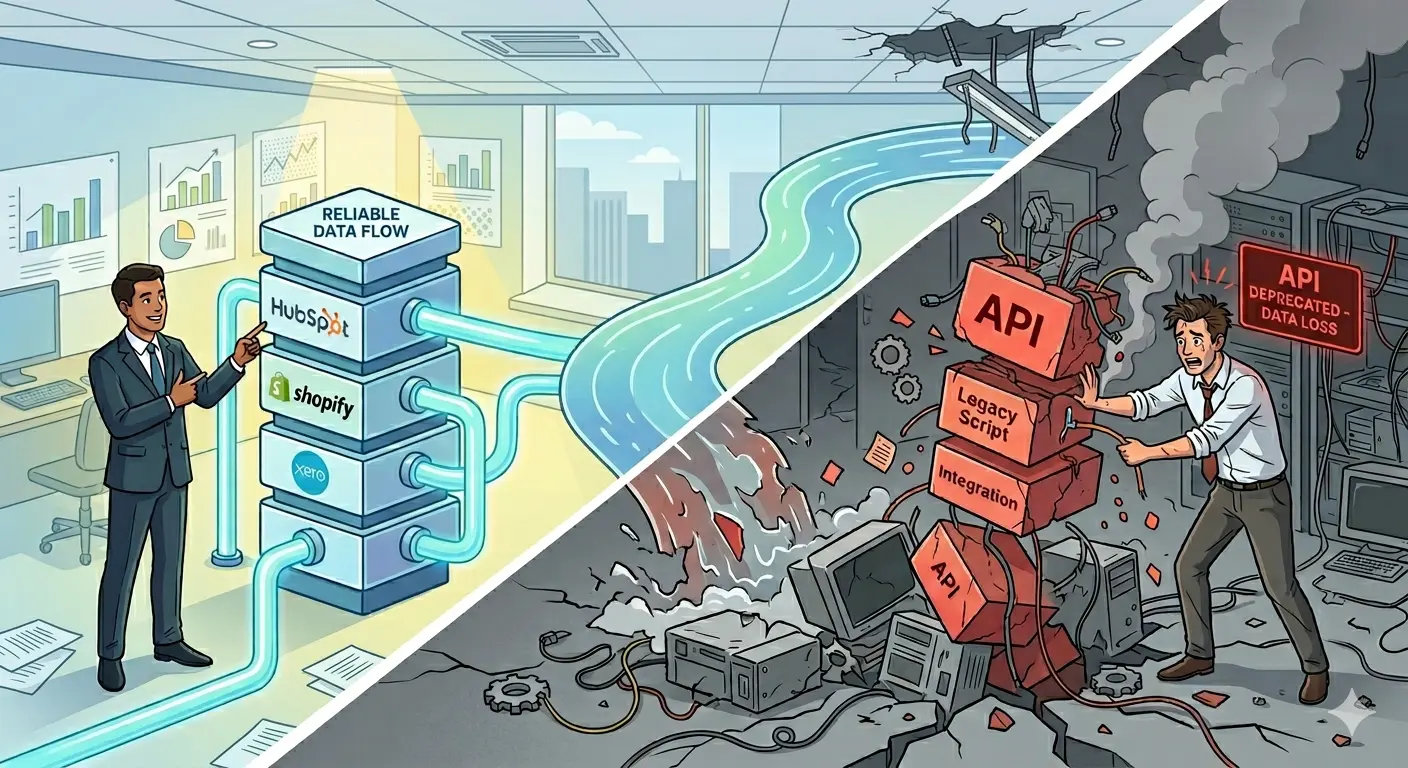
When you review your monthly balance sheets, you see a predictable, line-item graveyard of SaaS subscriptions. You pay HubSpot to manage your CRM, Shopify to run your storefront, and Xero to handle your books. Because everything is a subscription, it’s easy to treat every new recurring fee the same way - as a passive software tax that exists to do a job.
This subscription fatigue can create an operational blind spot. When an organization needs to connect these platforms, the instinct is to avoid adding yet another software subscription to the pile. Instead, they turn to freelancer marketplaces for a quick, one-off integration. The developer builds a custom script, verifies it works, hands it over, and then the engagement ends.
I saw this a lot in my career as a software engineer. The business owner assumes they’ve solved the problem - they’ve patched the gap, avoided a monthly overhead, and secured a fix. But digital infrastructure isn’t a static tool; it’s a living, shifting ecosystem. The moment that custom developer closes the contract, the clock begins ticking toward an inevitable, costly, and silent failure.
The Flaw of Transactional Builds
The appeal of a standalone project is obvious - it’s immediate, targeted, and keeps your recurring software expenses tidy. But this approach falls squarely into a transactional trap. A one-off project is scoped to build an automation for how your applications operate right now. The build stitches together endpoints using fragile self-serve no-code tools or unmonitored scripts that only account for the happy path.
Once the contract closes, that development resource moves on to the next project. No one is monitoring your systems day-to-day, and no one is keeping track of your business growth. If your internal team inputs an unexpected typo that crashes the script, the system silently chokes. Without oversight, your leads stop flowing, data corrupts, and if you don’t have anyone technical on the team, you can’t even start fixing it.
We recently stepped in to help a High-Volume E-Commerce Retailer facing this exact crisis. They had commissioned a standalone project to sync order data into their ERP. It worked beautifully for exactly three weeks - until a minor, routine field update broke the mapping and halted their fulfillment pipeline.
The Software Lifecycle
There’s a common sentiment in the software engineering world that “good software isn’t designed; it’s evolved”. And that’s what we see in the market today. Products are built, refined and iterated on; always changing, always moving forwards.
The real enemy of modern business automation isn’t inherently bad code - it’s Software Evolution. Every cloud tool in your stack is constantly changing under your feet. This phenomenon, known as API Drift, means that vendors routinely update their data structures, deprecate legacy endpoints, and alter authentication methods without checking if your custom, static script can handle it.
When you look at an ongoing fee for automated infrastructure, you aren’t just paying for code to sit on a server. You are buying an insurance policy that protects the thousands of dollars you are already spending on HubSpot, Shopify, or Xero. If the data pipeline between your CRM and your storefront breaks then not only do you have to pay for somebody to fix it, but you also have to put aside other work to process the data manually, costing even more in the long run.
Without continuous monitoring, you only discover these infrastructure breaks days later when an angry customer calls.
Outsourcing the Infrastructure
Choosing an ongoing managed service model doesn’t mean you are adding another passive SaaS tool to your credit card; you are outsourcing your technical infrastructure team. Instead of paying for static code, you are investing in operational continuity.
A robust, deterministic architecture needs to be built to handle the chaotic reality of modern software ecosystems. When a third-party app updates its data field or experiences an outage, a properly managed system handles the exception dynamically rather than crashing out.
Automation is never a product you buy once; it is a discipline you maintain. Relying on isolated, transactional black boxes ensures your core business pipelines remain fragile and exposed to the next minor software update. By treating your automated workflows as living infrastructure that requires dedicated, proactive maintenance, you insulate your business from operational shocks and maximize the value of your entire tech stack.
After all, you wouldn’t drive a car that hasn’t been serviced in ten years, would you?
Struggling to maintain broken workflows? Let’s talk about a technical rescue for your workflow.