The Disadvantages of Data Automation Nobody Puts in the Sales Pitch
 Ian Edwards
Ian is a senior engineer and the founder of Tessellium. Combining over a decade of technical experience with his background as a business owner, he specializes in untangling complex operational bottlenecks and getting stalled software projects over the finish line.
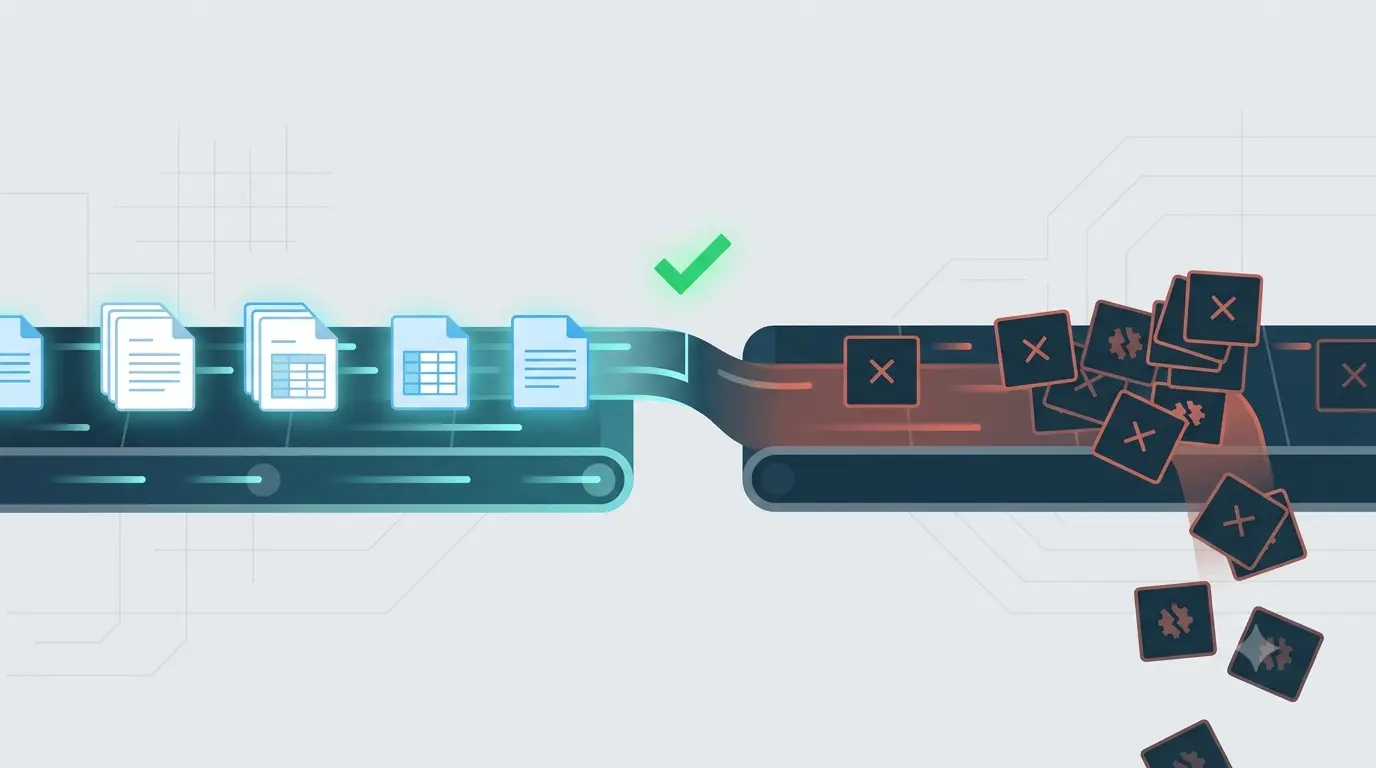
We build automations for a living, so it might seem strange for us to write about their downsides. But if you only ever hear the upside, you’re being sold to, not advised.
Automation is genuinely one of the best investments a growing business can make. It’s also one of the easiest to get wrong. The problem isn’t that the disadvantages are hidden - it’s that they arrive later than the benefits, long after the demo has ended and everyone’s moved on. By the time they show up, they don’t look like automation problems at all. They look like data problems, or staffing problems, or a bad quarter.
So here’s the honest counterweight to the sales pitch. These are the disadvantages of data automation worth taking seriously before you commit.
It costs time before it saves any
The first uncomfortable truth is that automation is a loan, not a gift. You pay the time up front - scoping the process, building the workflow, testing the edge cases - and you get repaid slowly, in small increments, over the months that follow.
That’s a great deal when the task is frequent and long-lived. It’s a terrible deal when the task only exists for the next fortnight, or runs twice a year. We’ve written before about deciding what to automate, and this is the crux of it: if the problem only exists in the short term, automating it can cost you more than just doing the job by hand ever would.
The disadvantage here isn’t automation itself. It’s automating the wrong thing, and only realising it once the invoice for your time has already been paid.
Mistakes scale exactly as fast as everything else
When a person copies data by hand and makes a mistake, they make one mistake. They fat-finger a single figure, catch it on the next row, and move on. Human error is slow, but it’s also self-limiting.
Automation removes that natural ceiling. A workflow that processes 800 orders a day will apply a flawed rule to all 800 without hesitation or doubt. The very thing that makes automation valuable - it does exactly what you told it, tirelessly - is the thing that makes a small logic error catastrophic. You don’t get one wrong invoice. You get a month of them before anyone notices.
This is why we’re so cautious about handing critical data to systems that don’t understand what the numbers mean. An AI agent doesn’t care about your balance sheet; it will corrupt your ledger with the same cheerful efficiency it would use to fill it correctly.
Failure gets quieter, not louder
When a human misses a task, there’s usually a trail. An empty inbox, an unanswered email, a colleague asking where the report is. Manual work fails loudly.
Automated work fails silently. The job runs on a schedule you’ve stopped watching, the API token expires, and the data simply stops flowing - but the dashboard stays green and nobody gets a phone call. This is the false confidence trap: you see a success notification once, decide the job is handled forever, and stop checking.
The result is that you can operate on stale or broken data for weeks without knowing. Automation doesn’t just introduce the possibility of silent failure; it makes it the default unless you deliberately design against it. That’s precisely why knowing an automation is actually working is a discipline in its own right, not something you get for free.
The maintenance never actually ends
There’s a comforting fiction that you build an automation once and then it just… runs. It doesn’t. Your automation lives in a tech stack that is constantly shifting underneath it - apps update, APIs change their responses, credentials expire, and the person who understood the workflow moves to another team.
A one-off build treated as finished is a ticking clock. Over time, integrations accumulate what we’ve called automation rot: dependency drift, cognitive debt for whoever inherits it, and edge cases that quietly multiply until the exceptions outnumber the standard cases. Every automation you own is a small ongoing commitment, not a solved problem. Own too many carelessly, and the maintenance bill can quietly overtake the hours you were saving in the first place.
You can lose touch with your own process
There’s a subtler cost that rarely gets discussed. When a task disappears into a black box, the understanding of how and why it’s done tends to disappear with it.
The person who used to reconcile the accounts by hand knew, instinctively, what a normal week looked like. They’d notice when a number felt off. Automate that away without care, and you can end up with a team that trusts the output completely but no longer understands the process well enough to spot when it’s wrong. You’ve swapped slow, knowledgeable work for fast work that nobody can sanity-check.
Good automation should free people from drudgery so they can apply that judgement elsewhere - not replace the judgement entirely.
Rigidity, when your business refuses to sit still
Automation is brilliant at doing the same thing, the same way, forever. Businesses are not brilliant at needing the same thing forever.
The moment your commercial reality gets more nuanced than the workflow you built - a bespoke pricing agreement, a new business unit, a client who insists on a different process - a rigid automation stops being an asset and starts being a constraint. This is the square peg problem: rather than the software adapting to your business, you find yourself warping the business to keep the software happy. An automation that only handles the happy path can quietly discourage you from evolving, simply because change has become expensive.
So when do the disadvantages win?
None of this is an argument against automation. It’s an argument for going in with your eyes open. The downsides tend to outweigh the benefits when:
- The task is short-lived or rare. You’ll never earn back the build time.
- Nobody owns the output. An unmonitored automation is a silent failure waiting to happen.
- The process is still changing week to week. Automate it once it’s stable, not while it’s a moving target.
- The cost of a scaled-up error is severe and hard to detect. High stakes demand human checkpoints, not blind trust.
Automate the opposite of those - frequent, stable, well-owned, and safe to check - and the disadvantages shrink to something you can manage. The businesses that get burned aren’t the ones that automated. They’re the ones that automated thoughtlessly, and mistook a quiet system for a healthy one.
The honest version of the sales pitch is this: automation is a genuinely powerful tool with a genuinely long list of ways to hurt you. Knowing both halves is what separates a good investment from an expensive lesson.
The best automation projects start by ruling out the bad ones. If you want a straight answer on whether a process is worth automating - or whether you’re better off leaving it alone - we’re happy to help.