How to Decide If a Task Is Worth Automating
 Ian Edwards
Ian is a senior engineer and the founder of Tessellium. Combining over a decade of technical experience with his background as a business owner, he specializes in untangling complex operational bottlenecks and getting stalled software projects over the finish line.
Everyone says “automate everything.” Nobody shows the maths.
The result? Teams either automate the wrong things (wasting budget on workflows that never pay back) or avoid automating the right things (leaving thousands in savings on the table because the business case felt too vague).
This article gives you a simple, honest calculator you can use today. No spreadsheets required. Just plug in your numbers and get a clear yes, no, or “let’s discuss.”
The Core Formula
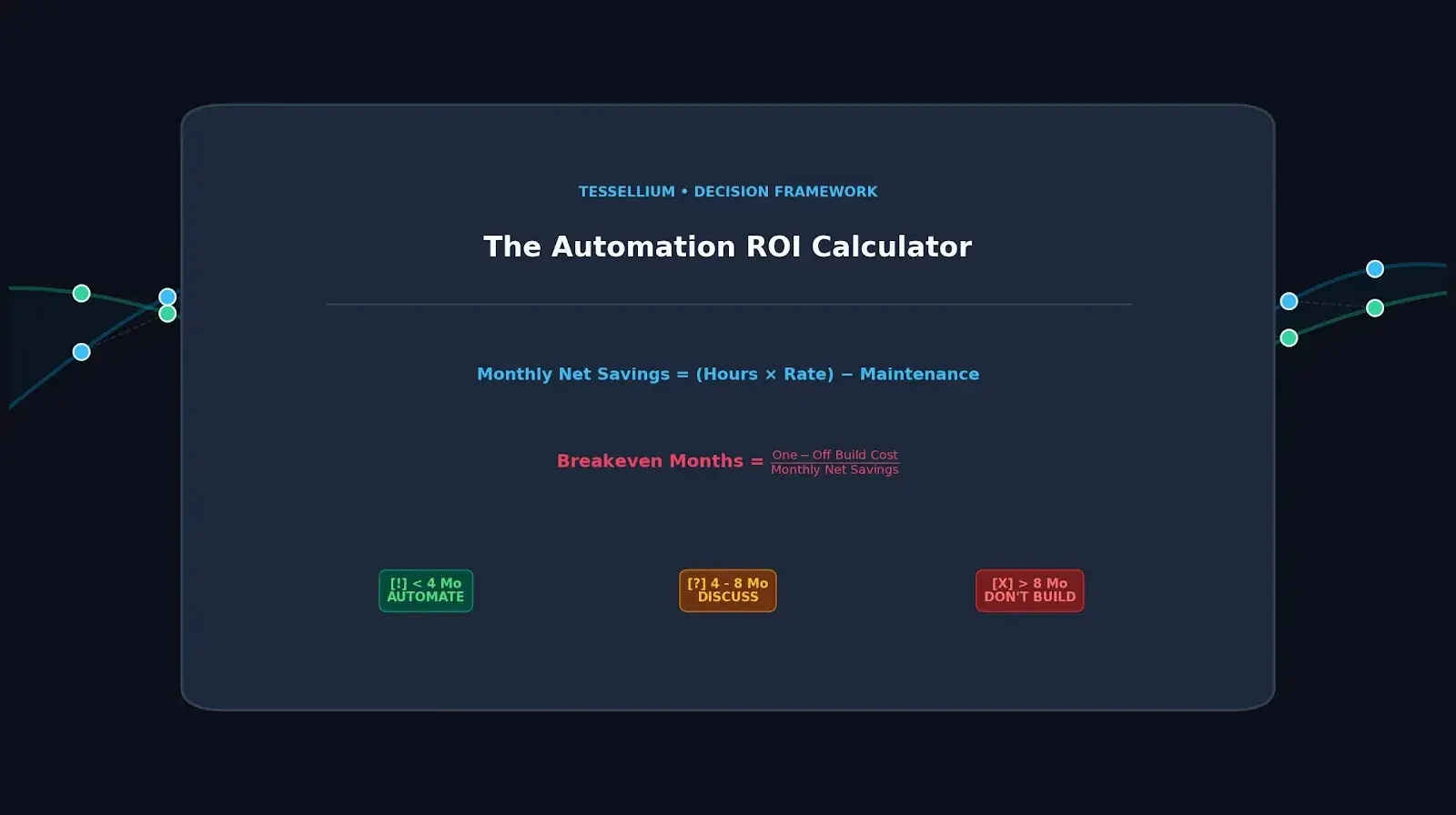
Monthly Net Savings = (Hours Saved × Frequency × Blended Hourly Rate) - Monthly Maintenance Cost
Breakeven Months = One-off Build Cost / Monthly Net Savings
Rule of thumb: If breakeven exceeds 6 months, don’t automate it yet. Revisit when volume grows or costs drop.
That’s it. Two formulas. Everything else is just filling in the variables honestly.
Worked Example: CRM → Accounting Invoice Sync
A real scenario we see weekly: a sales team closes deals in HubSpot, then someone manually creates invoices in Xero.
| Variable | Value | Notes |
|---|---|---|
| Time per manual invoice | 8 minutes | Including copy-paste and verification |
| Invoices per month | 120 | Typical for £2-5M turnover |
| Monthly hours saved | 16 hours | 120 × 8 / 60 |
| Blended hourly rate | £35 | UK SME average (admin + manager time) |
| Monthly value | £560 | 16 × £35 |
| One-off build cost | £2,500 | Custom n8n/Make workflow |
| Monthly maintenance | £150 | Monitoring, API changes, error handling |
| Net monthly savings | £410 | £560 - £150 |
| Breakeven | 6.1 months | £2,500 / £410 |
Verdict: Borderline. Worth it if invoice volume is growing. Skip if it’s stable or declining.
This is the honest answer most vendors won’t give you. The maths doesn’t always scream “yes” - and that’s fine. Better to know now than six months in.
The Hidden Costs Most People Forget
The formula above only works if you fill in real maintenance costs. Here’s what gets omitted from the average pitch deck:
1. Maintenance Tax (15-20% of build cost/year)
APIs change. Auth tokens rotate. Schema drift happens. A £2,500 build needs ~£400-500/year just to stay alive.
2. Monitoring Overhead
Someone must own “is it still working?” That’s not free. Even 15 minutes a week of a senior person’s time adds up.
3. Error Recovery
When (not if) it breaks, manual cleanup takes longer than the original task. Factor in 2-3 hours per incident.
4. Opportunity Cost
Developer hours spent building internal automations are hours not spent on your core product.
5. Cognitive Load
Your team must understand the automation well enough to trust it. If they don’t, they’ll shadow-run the manual process anyway - doubling the cost.
We’ve written about these traps before: The Disadvantages of Data Automation Nobody Puts in the Sales Pitch and When Automation Stops Being Useful cover the silent failure modes that turn “quick wins” into long-term liabilities.
Quick Decision Matrix
| Task Profile | Automate? | Why |
|---|---|---|
| High volume, stable, low variance | ✅ Yes | Clear ROI, low maintenance |
| Low volume, high variance | ❌ No | Build cost never recouped |
| High stakes (financial/legal) | ⚠️ Maybe | Needs human checkpoints, not full automation |
| Process changes monthly | ❌ No | Maintenance > savings |
| One-off / seasonal | ❌ No | Use a temp or spreadsheet |
If your task sits in the “Maybe” column, the calculator still works - just use conservative estimates for maintenance and error recovery.
When the Maths Lies: Qualitative Factors
Sometimes the numbers say “no” but the strategic answer is “yes.” Consider:
- Risk reduction: Compliance, audit trails, GDPR exposure
- Speed to customer: Lead response time, invoice speed, onboarding velocity
- Team morale: Eliminating soul-crushing work that drives turnover
- Scalability: Can you 10x volume without 10x headcount?
These don’t show in a simple ROI calc, but they change the business case. We cover this tension in Running Before You Walk - nail the deterministic basics first, then layer AI where it actually compounds value.
Your 5-Minute Audit Checklist
- List every recurring data transfer - anywhere someone copies data from Tool A to Tool B
- Time one cycle end-to-end - include verification, error correction, formatting fixes
- Multiply by monthly frequency - daily × 22, weekly × 4.3, be precise
- Apply your blended hourly rate - weight by who actually does the work
- Estimate build cost - internal dev hours × loaded rate, or get an external quote (+20%)
- Run the formula - if breakeven < 4 months → automate. 4-8 months → discuss. > 8 months → don’t
Don’t Want to Guess?
We’ve run this calculator for dozens of UK businesses. The pattern is always the same: 2-3 workflows with obvious ROI, 3-4 that look tempting but won’t pay back, and 1-2 the team didn’t even know existed.
Run the numbers and realised it’s time? Let us know and we’ll help you get started.