Scaling Success: How a Fragrance Retailer Reclaimed 15+ Hours Weekly via Automated Returns
 Ian Edwards
Ian is a senior engineer and the founder of Tessellium. Combining over a decade of technical experience with his background as a business owner, he specializes in untangling complex operational bottlenecks and getting stalled software projects over the finish line.
Growth is a double-edged sword for e-commerce brands. As order volumes climb, the gaps in a standard tech stack begin to widen.
For one Boutique Fragrance & Cosmetics Retailer, a successful product launch could see orders spike from 100 to over 800 in a single day. While their core stack of Shopify for sales and Shipstation for fulfillment handled the outbound journey competently, the inbound return journey presented a massive operational bottleneck.
The Challenge: A Critical Integration Gap
The retailer chose DPD to handle their UK returns, allowing customers to easily print labels and drop off packages. However, DPD lacks a native integration with Shipstation.
To make the returns system work, every single outbound shipment had to be manually registered in DPD’s system. This required:
- Manual Data Entry: Mapping 15 distinct data fields from Shipstation to the DPD API.
- Complex Logic: Manually filtering out non-returnable items (like gift samples) and identifying regions like Northern Ireland where different shipping rules apply.
- Administrative Burden: At peak volume, this would have required a dedicated team of admin assistants working full-time just to keep the returns portal functional.
The Solution: A Managed, Midnight Automation
Instead of hiring staff to manage spreadsheets, we implemented a custom “Done-For-You” automation via our platform. This wasn’t just a self-service tool the client had to maintain; it was a fully managed outcome.
Every night at midnight, the automation executes a four-step workflow:
- Retrieve: Pulls all Shipstation orders from the previous 24 hours.
- Filter: Automatically strips out orders with Northern Ireland postcodes and any line items without a SKU (non-returnable gift items).
- Map: Transforms the Shipstation data into the exact 15-field format required by the DPD API.
- Post: Syncs the data directly to DPD, ensuring that by the time the merchant wakes up, every customer from the day before is already “in the system.”
800-Order Peak Capacity: Automating Returns in Under 60 Seconds
By moving from potential manual entry to a managed automation, the retailer completely bypassed the need for additional admin overhead. Even on high-volume launch days, where orders can spike to 800 or more, the system scales effortlessly.
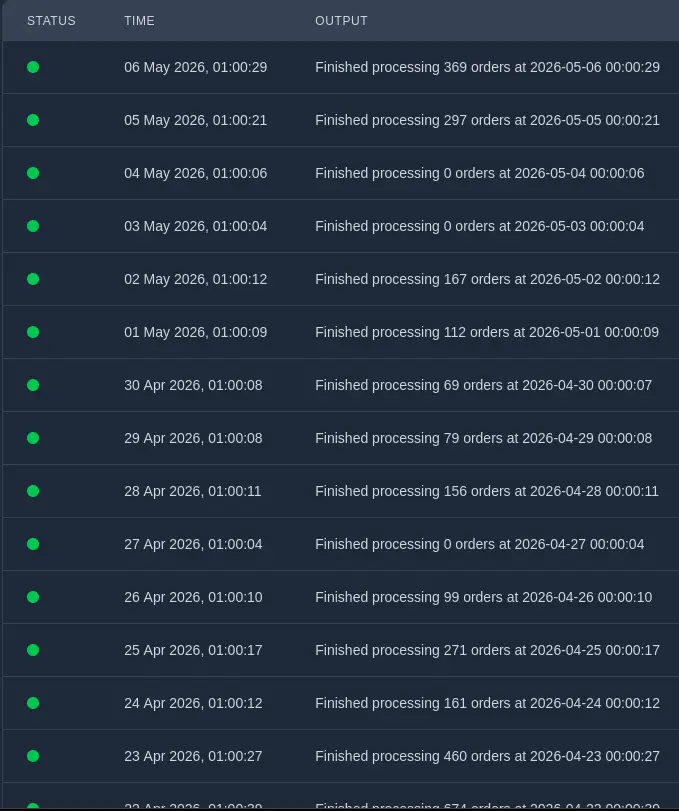
Real-World Execution Log (Typical Day):
"Finished processing 369 orders at 2026-05-06 00:00:29"
At this rate, a full day of peak orders is processed in roughly one minute. For a human clerk, that would take an entire workweek to input manually.
Key Outcomes:
- 15+ Hours Saved Weekly: Conservative estimate of admin time avoided during standard weeks, scaling significantly higher during peak activity.
- Zero Mapping Errors: Automated field mapping ensures that customer addresses and order details are 100% accurate every time.
- Managed Peace of Mind: Unlike self-service automation tools, this solution is monitored and maintained by our team. If the API requirements change, we fix it before the client even notices.
Conclusion
For high-growth retailers, the goal is to keep the team focused on brand and product, not data entry. By bridging the gap between Shipstation and DPD, we’ve ensured that this boutique brand can scale to over 1,000 orders a day without ever losing focus on the product and its customers.
Is your e-commerce stack holding back your scale? Get in touch to see how we can automate your fiddly workflows.